Comfort Always Trumps Breed-Standard Vanity
When a senior dog suddenly starts snapping during nail trims or hind-leg brushing after 11 years of polite behavior, it is almost never stubbornness—it is orthopedic pain. Pulling an arthritic hip outward laterally ("fire-hydrant style") grinds bone-on-bone cartilage. In geriatric grooming, the goal shifts 100% from showroom scissoring to painless hygiene, traction, and short session times.
1. Orthopedic Biomechanics: How to Lift Paws Without Hurting Arthritic Joints
Healthy canine shoulders, elbows, hips, and stifles (knees) are hinge-dominant joints designed primarily for sagittal plane motion—swinging straight forward and straight backward along the line of the body. They have very limited safe lateral abduction (swinging sideways away from the ribs).
Unfortunately, untrained owners and rushed bathers frequently grab a dog's paw and pull it out to the side like opening a car door so they can see the bottom of the foot. On a dog with osteoarthritis, hip dysplasia, luxating patellas, or cruciate ligament disease, sideways abduction causes sharp joint-capsule pain—and forces the dog's remaining three arthritic legs to bear 133% of their normal load on a slick surface.
The 4 Farrier-Style Joint Rules for Senior Dogs
- Fold Backward Along the Natural Track, Low to the Floor: For front paws, bend the carpus (wrist) gently backward underneath the elbow so the forearm stays tucked directly beneath the shoulder—keeping the paw just 2 to 3 inches off the mat while you look down over the dog's shoulder. For hind paws, fold the hock gently straight backward along the hip line without extending the hip past neutral or pulling the knee outward.
- 3-Second Micro-Holds With Thick Closed-Cell Foam Mats: Never ask an arthritic dog to balance on three legs for two full minutes while you clip and grind all four toes! Clip one nail, set the paw back down on a thick yoga or orthopedic grooming mat for five seconds so they reset their balance, then lift for the next nail.
- Clip & Brush Lying Down Whenever Possible: Roughly 75% of a senior dog's groom can be completed while they lie comfortably in sternal ("sphinx") position or rolled onto a thick fleece towel on one side, flipping once to finish the opposite flank! Only stand them briefly for the belly/sanitary skim—supported gently under the abdomen (never pressing into soft organs; place a wide padded belly sling directly ahead of the pelvic brim for 30 seconds at a time).
- Coordinate Pain Medication Timing With Your Veterinarian: If your senior dog takes daily veterinarian-prescribed NSAIDs (such as carprofen or grapiprant) or gabapentin for arthritis, ask your vet about scheduling grooming appointments roughly 90 to 120 minutes after their morning dose so peak analgesia protects their joints during bath and nail care.
2. "Senior Warts" (Sebaceous Adenomas) & Thin Skin: Mapping Before Clipping
Starting around age 8 or 9—especially in Poodles, Bichons, Cocker Spaniels, Shih Tzus, Maltese, and Doodles—dogs commonly develop benign cauliflower-shaped pink growths called sebaceous adenomas (colloquially called "old dog warts") hidden beneath thick curls. If a groomer runs a #7F or even a #5F clipper blade across the back without mapping those bumps first, the moving cutter teeth slice the vascular top right off the adenoma, causing stubborn bleeding.
- Maintain a Written "Bump Map" Card: Every salon groomer worth hiring keeps a body-diagram card on file marking every new mole, skin tag, lipoma, and sebaceous adenoma by clock-position ("pea-sized pink wart 2 inches left of C7 withers; cluster of 3 on right stifle"). Update your groomer at drop-off whenever a new bump appears!
- Use Stainless Guard Combs Over a #30/#10 Blade Instead of #7/#5 Steel Blades: Smooth, rounded stainless-steel snap-on attachment combs (
3/8"or1/2") glide safely over small benign warts while keeping the cutting teeth raised off fragile geriatric skin. Over large pedunculated (stalked) growths, cover the wart directly with your non-dominant fingertip and hand-scissor around your finger!
3. Grooming Blind, Deaf & Cognitively Declining Seniors
When cataracts cloud vision or cochlear degeneration dulls hearing, sudden clipper vibration or air movement startles a senior dog violently:
- The Continuous Touch Anchor: When grooming a blind or deaf dog, keep one gentle hand resting lightly on their shoulder or flank continuously while moving around the table. Never lift both hands away and suddenly touch their hindquarters or muzzle out of thin air—instead, touch their shoulder gently and slide your hand down to the leg or chin so they feel your approach.
- Skip High-Velocity Nozzles Near the Head & Ears: Deaf dogs still feel intense barometric air pressure against their eardrums and vibrissae (whiskers), which triggers panic when they cannot hear where the wind is coming from. Towel-squeeze facial hair thoroughly with super-absorbent PVA chamois towels and finish drying the head with a quiet, handheld fluff dryer held at arm's length on warm-low.
4. Brachycephalic Breeds (Frenchies, Pugs, Bulldogs, Shih Tzus, Persians): Why Heated Cage Dryers Are Deadly
Dogs do not sweat across their bodies like humans; they dissipate over 80% of excess core body heat through evaporative respiratory cooling—panting air rapidly across moist nasal turbinates and the tongue.
Brachycephalic ("short-skulled") breeds—including French Bulldogs, English Bulldogs, Pugs, Boston Terriers, Pekingese, Shih Tzus, Cavaliers, Boxers, and Persian/Exotic Shorthair cats—have compressed skulls containing the same volume of soft palate, tongue, and pharyngeal tissue as a normal-muzzled animal. Many suffer to varying degrees from BOAS (Brachycephalic Obstructive Airway Syndrome): pinched nostrils (stenotic nares), an elongated soft palate Partially blocking the larynx, and a narrowed trachea.
| Salon / Home Hazard | Why It Endangers Flat-Faced Pets | Mandatory Safe Protocol |
|---|---|---|
| Heated Enclosed Cage Dryers | Warm humid air trapped inside a closed kennel prevents evaporative panting cooldown; core temp can rocket past 105°F (40.5°C) into fatal heatstroke & laryngeal edema within 12–15 minutes! | 100% Zero-Heat Open-Air Rule: Never place any brachycephalic pet inside a heated cage dryer. Dry in an air-conditioned room (68–72°F) using microfiber towels + ambient room-temp air only, under continuous 1-on-1 visual supervision. |
| Tight Neck Grooming Loops | Pulling upward or backward against the throat compresses an already hypoplastic trachea, triggering gagging, cyanosis (blue gums), or syncope. | Use a figure-8 / cross-body harness loop routed under one front armpit so gentle security rests across the sternum and shoulder rather than the windpipe. |
| Protruding Shallow Eyes (Lagophthalmos) | Pugs, Shih Tzus, and Persians have shallow orbital sockets; rubbing with rough towels, blast-drying toward the face, or dripping shampoo causes instant corneal ulcers. | Apply vet-approved sterile ophthalmic lubricating gel drop before bathing (if directed), wash faces exclusively with a damp microfiber cloth + tearless micellar cleanser, and never aim forced air toward the eyes. |
Emergency Brachycephalic Overheating Signs — Stop Immediately!
If a flat-faced dog exhibits harsh raspy "sawing" inspiratory stridor, wide spoon-shaped dark brick-red or bluish-purple tongue edges, thick ropy white foam in the throat, glazed eyes, or wobbling legs during a bath or nail trim: abort the groom immediately. Move them onto cool tile in front of air conditioning, wet their paw pads, groin, and ear flaps with cool (not ice-cold, which constricts surface blood vessels!) water, offer small licks of water without forcing swallowing, and transport directly to an emergency veterinarian.
5. Daily Nasal Rope, Lip & Tail-Pocket Fold Hygiene
Deep facial wrinkles ("nasal ropes" over the nose of Bulldogs and Pugs), drooping lip folds on Spaniels, and tight corkscrew "tail pockets" trap tear moisture, food crumbs, and sebum at 101°F—creating raw, malodorous fold intertrigo within days if left damp.
- Never Leave Water Inside Wrinkles After a Bath! Cleaning a fold without drying it makes yeast worse. Gently roll the wrinkle open with your thumb.
- Wipe One Direction Only With Vet-Formulated Antiseptic/Chlorhexidine/Ketoconazole Pads: Use a fresh corner of an unscented veterinary fold wipe (avoid alcohol-heavy human baby wipes!) for each fold so you don't transfer bacteria from a tail pocket up toward the eyes. Be doubly careful around the nasal rope so prominent Pug/Bulldog corneas are never brushed by the pad edge!
- Pat Bone-Dry & Apply Thin Barrier Balm (If Uninfected): Pat every crevice completely dry with soft gauze or tissue. For dogs with heavy tear overflow into the nasal rope, ask your veterinarian about a thin swipe of zinc-free, fragrance-free skin barrier paste to repel salty tears between daily wipes.
6. Designing the "Senior Comfort Clip" With Your Groomer
If your 14-year-old Shih Tzu, Poodle, or Doodle trembles after standing through a 2.5-hour hand-scissored teddy bear trim, give yourself permission to request a Senior Comfort Clip:
- Body & Legs in a Clean
#4F(9.5mm) or3/8"Comb: Dries in half the time, eliminates painful home slicker-brushing battles over bony hips, and prevents urine or stool from clinging to feathered hind trousers. - Clean Chin & Feet ("Poodle-Style Clean Feet" Optional for Arthritic Dogs): Clipping soggy beard hair short prevents wet lip-fold dermatitis when seniors dribble water, and keeping paw pads scooped cleanly with a
#10mini-trimmer gives maximum leather grip on hardwood floors. - Split Appointments When Needed: Many compassionate one-on-one and mobile groomers gladly do Bath + Nails on Tuesday (35 minutes) and Haircut Tidy on Thursday (30 minutes) so fragile heart-murmur or tracheal-collapse seniors never exceed their stamina ceiling.
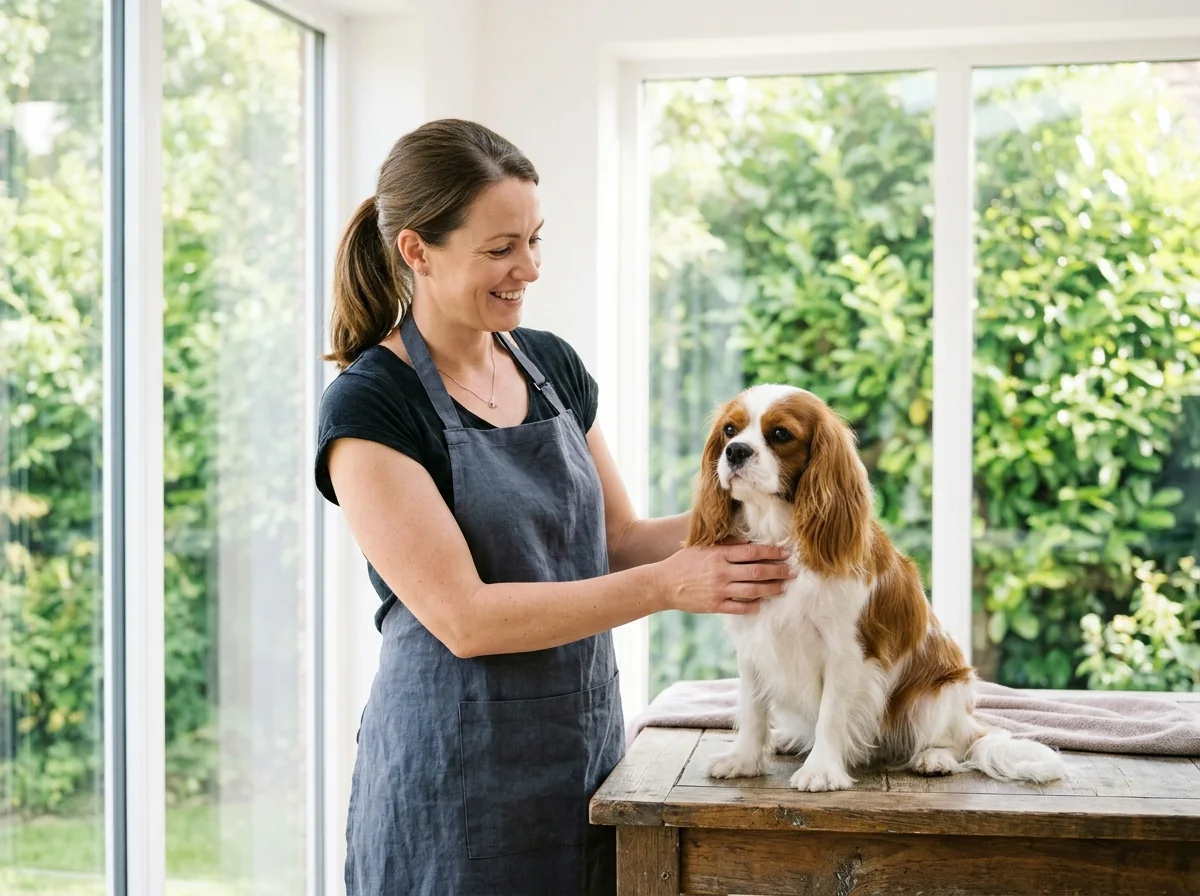
Written by Sarah Jenkins
Sarah specializes in geriatric comfort rehabilitation and strict zero-heat brachycephalic handling protocols. Read full bio & welfare standards →