
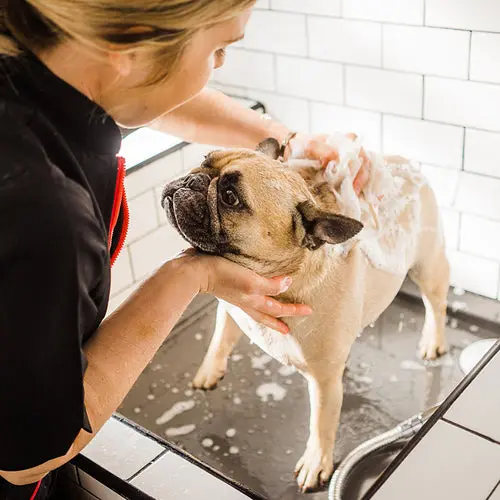
Quick Chemistry Takeaway
Human scalp skin is distinctly acidic (pH 5.2–5.5) and protected by 10 to 15 layers of stratum corneum cells. Canine skin is nearly neutral (pH 6.5–7.5, up to 8.0 in some breeds) and only 3 to 5 cell layers thick—thinner than human newborn skin. Even "tear-free" human baby shampoo is roughly 10 to 50 times too acidic for routine canine bathing.
1. Why Human Baby Shampoo & Dish Soap Strip the Canine Lipid Barrier
Because the pH scale is logarithmic, a single full point difference represents a tenfold shift in hydrogen ion concentration. Human shampoos are formulated around pH 5.5 to reinforce the human "acid mantle." When applied to a dog whose healthy epidermal surface sits near pH 7.0, two damaging reactions happen simultaneously:
- Intercellular Ceramide Stripping: Acidic human cleansers dissolve the thin ceramide-and-cholesterol mortar holding your dog's 3-to-5-layer stratum corneum together. Within 24 to 48 hours, transepidermal water loss (TEWL) spikes, producing powdery white dander and relentless flank scratching.
- Microbiome Dysbiosis: When the lipid barrier cracks and local micro-inflammation rises, opportunistic commensal organisms—specifically Staphylococcus pseudintermedius bacteria and Malassezia pachydermatis yeast—multiply rapidly inside warm skin folds, armpits, and interdigital paw webs.
What about blue Dawn dish soap? Dish detergent is an industrial kitchen degreaser loaded with high-concentration anionic sulfates. While wildlife rescuers and emergency clinics legitimately use it once to strip crude oil, motor grease, or non-medicated adult flea overload on puppies too young for topical parasiticides, using dish soap for regular dog baths destroys coat Sebum and accelerates rebound "wet dog" odor within days.
2. Reading the Ingredient Deck: Gentle vs. Harsh Surfactants
In the United States, pet shampoos that make purely cosmetic claims ("deodorizing," "whitening," "moisturizing") are not regulated with the same mandatory INCI ingredient-order rules as human cosmetics unless they carry an EPA pesticide registration or FDA drug monograph. When evaluating a bottle, look past front-label illustrations and inspect the cleansing base:
- Preferred Mild Surfactants (Coconut, Sugar & Amino-Acid Derived): Coco-glucoside, decyl glucoside, lauryl glucoside, cocamidopropyl betaine, sodium lauroyl sarcosinate, and sodium cocoyl isethionate. These lift sebum, pollen, and lawn dust without denaturing keratin proteins.
- Heavy Degreasing Sulfates (Reserve for Clarifying First-Wash Only): Sodium lauryl sulfate (SLS) and concentrated ammonium lauryl sulfate (ALS). In professional salons, we only reach for a clarifying sulfate wash on severely greasy Cocker Spaniel seborrhea, skunk oil, or heavy wax buildup—and we immediately follow with a lipid-restoring conditioner.
- Optical Brighteners vs. Bleaches on White Coats: Quality "whitening" shampoos for Maltese, Bichons, Samoyeds, and Westies do not contain peroxide or chlorine bleach (which turns white keratin permanently brittle and yellow!). Instead, safe bluing/violet shampoos use microscopic violet pigments or gentle enzymatic stain lifters to optically neutralize rusty porphyrin tear and saliva tones. Never get bluing shampoo inside the eye, and never leave it undiluted on porous dry hair or your dog may turn pastel lavender!
3. Veterinary & Therapeutic Shampoo Actives: Choosing the Right Molecule
One of the biggest mistakes well-meaning owners make is buying a soothing colloidal oatmeal shampoo when their dog actually has a yeast overgrowth (recognizable by a musty corn-chip odor, rusty-brown paw staining, or greasy elephant-like skin in the groin). While colloidal oatmeal brilliantly calms dry winter itch or pollen allergies, pouring carbohydrate-rich oat flour onto active Malassezia yeast without an antifungal agent fails to address the infection and leaves damp residue behind.
| Active Ingredient | Primary Target Condition | Required Contact Time | Crucial Salon & Home Warnings |
|---|---|---|---|
| Chlorhexidine Gluconate (2%–4%) | Superficial bacterial pyoderma (Staph pustules, hot spots, chin acne) & mild yeast | 10 full minutes on wet skin before rinsing | Keep strictly out of eyes (corneal ulcer risk) and never flush into an ear with a ruptured eardrum. Binds to skin proteins for 48+ hr residual protection. |
| Ketoconazole (1%) or Miconazole (2%) | Malassezia yeast dermatitis (musty "Frito" smell, greasy yellow scales, itchy paws/folds) | 10 full minutes (often paired 50/50 with Chlorhexidine) | Must massage deep between toes, under armpits, and groin folds—not just along the back hair! Rinse thoroughly with lukewarm water. |
| Benzoyl Peroxide (2.5%–3%) | Follicular flushing: Schnauzer comedo syndrome, deep follicular plugs, extreme greasy seborrhea oleosa | 5 to 10 minutes | Severely drying and bleaches dark fabrics/towels! Always follow with a lightweight, veterinary-approved humectant spray or rinse if prescribed. |
| Salicylic Acid + Sulfur (2%/2%) | Keratolytic & keratoplastic scaling: thick crusty plaques, seborrhea sicca, ear-margin dermatosis | 5 to 10 minutes | Loosens dead flaky corneocytes safely. Avoid using salicylic acid shampoos on cats without explicit veterinary supervision due to feline salicylate sensitivity. |
| Colloidal Oatmeal (1%–2%) + Pramoxine / Ceramides | Dry winter itch, acute grass/pollen contact allergy, post-clipping razor irritation on non-yeasty skin | 5 to 8 minutes with cool-to-tepid water | Use cool/tepid water (80–86°F / 27–30°C)—warm water dilates histamine capillaries and worsens itching immediately! |
4. The 10-Minute Timer Rule (Why Most Medicated Baths Fail at Home)
When a veterinary dermatologist prescribes a 3% chlorhexidine or ketoconazole shampoo twice weekly, owners frequently report after two weeks: "It didn't work at all!" When I ask them to walk me through bath night, 9 out of 10 admit they lathered the dog, scrubbed for 90 seconds while their wet dog tried to jump out of the tub, and rinsed right away.
Antimicrobial and antifungal actives require 8 to 10 uninterrupted minutes of direct skin contact to penetrate lipid biofilms and disrupt microbial cell membranes. Here is how professional groomers keep a dog calm in the tub for 10 full minutes without chilling them:
- Clarify First if Dirty or Greasy: Medicated shampoo cannot reach skin cells through a layer of mud or rancid sebum. Do a quick 60-second pre-wash with a mild tearless/hypoallergenic cleanser, rinse completely, and squeeze excess water out of the coat so it doesn't dilute your prescription active.
- Apply to Problem Zones First: Start lathering the feet, groin, armpits, neck folds, and base of the tail first—that way the worst areas get the full 10+ minutes while you work upward across the trunk.
- Use a Suction-Cup Lick Mat & Set a Phone Timer: Smear a tablespoon of xylitol-free peanut butter, pumpkin puree, or cream cheese (verify allowed foods if your dog is on a strict hydrolyzed diet!) onto a textured silicone lick mat stuck to the shower wall. Start your 10:00 timer only after the foam touches the skin.
- Rinse Twice as Long as You Think You Need: Dried surfactant residue left under dense Golden Retriever or Doodle undercoats causes post-bath "hot spots." Rinse with lukewarm water until the coat squeaks between your fingers and water squeezing off the belly and between every toe pad runs crystal clear.
5. Professional Dilution Ratios (Why Pouring Raw Shampoo Straight on the Back Backfires)
Walk into any professional grooming bathing room and you will see plastic Yorker-spout mixing bottles lined up beside gallon jugs. Professional groomers almost never squeeze thick, undiluted cosmetic shampoo straight down a dog's spine (with the sole exception of ready-to-use veterinary medicated liquids whose labels state "do not pre-dilute").
- Standard Salon Dilution (8:1 to 16:1): Most concentrated salon shampoos are engineered to be mixed 1 part shampoo to 10 or 12 parts warm water inside a squeeze bottle right before the bath. Pre-diluted foam penetrates straight down through water-repellent double coats to the skin in seconds and rinses out 3x faster with zero sticky dorsal stripe.
- Discard Unused Diluted Shampoo Same-Day! Never pre-mix a big bottle of diluted shampoo and store it in your shower for next month! Tap water dilutes the shampoo's preservative system below effective thresholds, allowing Pseudomonas aeruginosa and Serratia bacteria to multiply inside the bottle within 24 to 48 hours—causing catastrophic bacterial skin infections on the next dog bathed! Mix only what you will use in today's bath, then rinse and air-dry the mixing bottle upside down.
6. Critical Warning for Multi-Pet Homes: Essential Oils & Permethrin
Never Share Dog Flea or Botanical Shampoos With Cats
Cats lack functional hepatic UGT1A6 glucuronosyltransferase enzymes required to metabolize phenols, terpenes, and synthetic pyrethroids. Dog flea shampoos containing permethrin or phenothrin, as well as "natural" dog shampoos spiked with concentrated tea tree (melaleuca), pennyroyal, peppermint, citrus/d-limonene, eucalyptus, or pine oil, can trigger fatal neurotoxicity or liver failure in cats—even if a cat simply grooms a freshly washed dog housemate. Read our Feline Grooming Safety Manual before bathing any cat.
7. Managing Coastal Humidity & Swimmer Coats Between Baths
Having groomed thousands of dogs in South Florida's year-round humidity, I see how saltwater, chlorinated pools, and damp Bermuda grass wreak havoc on canine skin. You do not need harsh shampoo every time your Labrador swims:
- Post-Pool / Post-Beach Fresh Water Rinse: Salt crystals draw moisture out of keratin shafts, and pool chlorine oxidizes dark coats reddish-bronze while drying the epidermis. A 2-minute lukewarm fresh hose or tub rinse followed by thorough velocity or microfiber drying prevents salt/chlorine itch without stripping sebum.
- Close the Cuticle With Conditioner: Many owners skip dog conditioner thinking it makes coats "greasy." In reality, shampoo lifts the hair shaft's cuticle scales slightly alkaline/open; a lightweight, silicone-light canine conditioner (pH ~6.5) smooths cuticles flat, reduces static brushing breakage by over 50% on Doodles and Spaniels, and replenishes lost surface lipids.
Written by Sarah Jenkins
Sarah partners closely with local veterinary dermatology clients to execute therapeutic bathing regimens and preserve fragile canine skin barriers. Read full bio & credentials →